-
Western and Eastern Philosophy
Western Philosophy:
The idea of premarital sex has evolved over time in Western philosophy. Western thinkers, who have historically been inspired by Judeo-Christian ideas, frequently saw premarital sex as ethically reprehensible. Immanuel Kant and other philosophers stressed the value of moral accountability and the maintenance of sexual interactions in marriage. According to consequentialist theory, premarital sex should be evaluated in light of its social and individual repercussions, taking into consideration elements like pleasure and well-being. This view was advanced by intellectuals like John Stuart Mill.
However, attitudes against premarital sex have changed recently in Western thinking. The emphasis on individual freedom and the rejection of societal norms was emphasized by contemporary thinkers like Simone de Beauvoir and Jean-Paul Sartre. They contend that everyone has the right to freely participate in sexual interactions with others, even those that do not include marriage. Traditional ideas about sexuality have also been questioned by feminist thinkers like Judith Butler, who promotes gender equality and the freedom of sexual preference.
Eastern philosophy:
Different viewpoints on premarital sex may be found in Eastern philosophy, which includes religions like Hinduism, Buddhism, Confucianism, and Taoism. These practices frequently address the subject from more comprehensive moral and spiritual growth perspectives.
Buddhism encourages moderation and restraint in all facets of life, including sexual behavior, whereas Hinduism places an emphasis on restraint and self-control, including sexual abstention from premarital sex. It does, however, recognize that personal circumstances and societal norms can have an impact on moral judgments on premarital sex.
Premarital sex is often discouraged in Confucianism because it fosters societal peace and children's purity. Taoism, on the other hand, adopts a more lenient attitude on a larger scale, emphasizing natural spontaneity and harmony with Taoism. Humans must be seen in the context of their relationship with mother nature. Respecting nature will result in happiness. It exhorts people to act on their feelings and wants as long as they do not hurt others.
In conclusion, Western philosophy has shifted towards individual autonomy, whereas Eastern philosophy places a greater emphasis on harmony, moderation, and conformity to traditional standards. Both viewpoints offer insightful information on premarital sex and take moral, ethical, and spiritual matters into account.
A system that seeks to reach reasonable conclusions based on the information available is referred to as logic. It also can be defined as the philosophy that distinguishes good and bad reasonings by investigating normative criteria for valid conclusions and demonstrations. This indicates that the aim of logic is to draw conclusions from the evidence. Everyone in this world has logic. For some people, sex before marriage is normal, but there are also those who say sex before marriage is not normal or taboo. The reasons behind individuals' choices to have sex before marriage are influenced by a wide range of personal, cultural, social, and individual factors, which may vary from person to person.
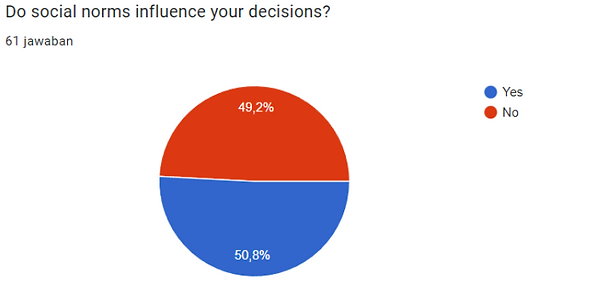
According to the research done by the group, the majority of the respondents (above 95%) do not want to engage in premarital sex because they are aware that there are physical and emotional risks in engaging in premarital sex. This is a logical statement because they provide good reasoning. Furthermore, from a logical standpoint, people think that engaging in premarital sex is riskier as there are no official relationships to rely on.
On the other hand, people that want to engage in premarital sex argue that they do it just for fun. This argument is flawed and lacks logical rigor. It is too subjective and overlooks important considerations, such as the risks mentioned above. From a logical perspective, it is called bad reasoning. Logically, there are plenty of activities besides sex that one can engage in to have fun, such as playing games, sports, doing hobbies, and many more.
Sex before marriage is unacceptable in Indonesian culture, especially within conservative and religious communities. The logical reason for that is Indonesia is a predominantly Muslim country, and Islamic teachings strongly emphasize the importance of abstaining from sexual relations before marriage.
To conclude, there is no absolute answer to the problem of premarital sex from a logical perspective. We can’t really say that it is right or wrong. As long as both parties consent and acknowledge the risks, then it is justified. We must not and should not judge everyone’s decisions and points of view.
-
Ideology- Modernism, Postmodernism, Relativism
Modernism, postmodernism, and relativism are unique philosophical and cultural movements that are used in various fields.
In the case of modernism, people saw a cultural movement in the late 19th and early 20th centuries. As innovation, progress, and individualism started being more prevalent in society, younger generations became more experimental as a whole. They often face challenges as they grow into young adults while “struggling to fit into society”. Peer pressure and media can encourage and pressure them into engaging in activities such as consuming alcohol and having intercourse. (Acharya et al., 2015)
In the late 20th Century Postmodernism was born from the growing rejection of the modernism ideology (Benjamin, 1989). In the context of premarital sex, it emphasizes freedom of choice and autonomy. Postmodernism also acknowledges the importance of individual choice and the right to choose one's own sexual practices. This way, premarital sex can be viewed as an expression of intimacy, a way for individuals to explore their desires and form connections on their own terms.
Relativism is a stance that argues that moral or ethical truths aren’t absolute but instead relative to individuals, cultures, or contexts (Baghramian & Carter, 2020). From this standpoint, there isn’t a universal norm to judge individuals who engage in premarital sex. Instead, it’s seen as a matter of personal choice and cultural interpretation. Different societies, religions, and individuals may hold many different views on premarital sex, and these views are considered equally valid within their respective contexts.
The systematic study of God is known as theology; it derives from the Greek words for knowledge and for God, theos, and logos. It can also be thought of as the "Study of God" or the "Discourse about God” (Imm, 2021). However, theology studies not just the study of God but also the rituals, writings, beliefs, and practices of many religions.
Furthermore, there are some people who do not believe in god or people known as an atheist. According to 32% of atheists, their parents had no religious affiliation when they were young (Antonucci, n.d.). It can be tough to shift from a profoundly ingrained childhood attitude. Because of that reason, it can affect their point of view on premarital sex.
Every religion bears a different point of view and is lived according to its adherents. For instance, in Christianity, premarital sex is a part of sexual immorality. Based on 1 Corinthians 7:2 "But since sexual immorality is occurring, each man should have sexual relations with his own wife, and each woman with her own husband.". It clearly states that premarital sex is part of the definition of sexual immorality, which all Bible passages condemn premarital sex as being sinful (Riggleman, 2020).
In conclusion, Christianity strongly opposes having sex before marriage. The words "premarital sex" are never mentioned, but it is against God's design.
Ethics describes a person’s behavior in conducting activities based on moral principles. This branch of philosophy falls under the practical philosophies and helps guide people to tell the truth, keep promises, and help someone in need.
By definition, sexual ethics focuses on human sexuality and behavior, which could be related to premarital sex. Towards the philosophy, premarital sex ethics can be used to acknowledge the view of the activity, which is sex activity amongst unmarried people on a daily basis. In Christianity ethics, all sex behavior before marriage is considered a threat to the institutions of marriage and family and shows a lack of discipline. However, according to the Western ethics, premarital sex is morally acceptable as long it is consensual, respectful, and protected, yet it is feared due to the high number and chances of unwanted pregnancy. In addition, some suggest that sex is important, an expression of love, and should be celebrated, yet it could corrupt a person's life. As far as being concerned, sex before and after marriage is viewed differently from many perspectives. Moreover, pre-marital sex poses some threat to all ethics with some views that strictly oppose having sexual intercourse before marriage.
Philosophy of Sejahtera, also known as Philosophy of Prosperity, is a viewpoint that prioritizes the holistic well-being (spiritual), intellectual, and prosperities of individuals on all levels of society. It is the implementation of Rukun Negara and the National Education Philosophy (NEP). As the implementation of the philosophies, Philosophy of Sejahtera carries the values held by both Rukun Negara and NEP. These values can be linked with the problem of premarital sex in several ways:
Relationship with God:
One of the most important objectives that the philosophy wants to achieve is to strengthen the relationship between human beings and god, which is the first and the most essential principle in Rukun Negara. Most religions such as Buddhism, Islam, Christianity, and Judaism prohibit sexual intercourse outside marriage (The Spiritual Life, n.d.).This is in line with the findings of the group’s research, with most Indonesian respondents not wanting to engage in premarital sex because of their cultural and religious beliefs (Indonesia has a Muslim-majority population).
Social Harmony and Value:
The Philosophy of Sejahtera stresses the importance of social harmony and shared value in a community. In the case of premarital sex, sexual activity before marriage is frowned upon or forbidden in many societies. Having sexual relations before marriage can cause tension and conflict in families and neighborhoods. In this case, the Philosophy of Sejahtera plays a role to established norms and standards to preserve societal harmony.
To conclude, the Philosophy of Sejahtera aims to create better individuals and society as a whole, which includes spiritual, physico-psychological, intellectual, cultural, cognitive, ethical, emotional, ecological, economic, and societal – all in a balance (Razak, 2019). Because the problem of premarital sex can cause conflicts and clashes with the principles of the philosophy, it can be said that the Philosophy of Sejahtera indirectly disapproves of premarital sex.